ticalc.org
Basics Archives Community Services Programming
Hardware Help About Search Your Account
   Home :: Archives :: File Archives :: Aberration?
Aberration?

FILE INFORMATION

Ranked as 12657 on our all-time top downloads list with 2703 downloads.
Ranked as 6610 on our top downloads list for the past seven days with 3 downloads.

aberration.zip
Filename aberration.zip
Title Aberration?
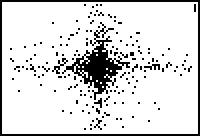
Description See the read me for full details. In short, this program does something that Im pretty sure it shouldn't. See the text file.
Author Wesley Cowan (polar_ice_cat@hotmail.com)
Category TI-83/84 Plus BASIC Graphics Programs
File Size 985 bytes
File Date and Time Sun Jul 7 13:12:58 2002
Documentation Included? Yes

SCREEN SHOTS

RATING

If you have downloaded and tried this program, please rate it on the scale below
BadGood
1  2  3  4  5  6  7  8  9  10  

REVIEWS

Review
Review by  Joe Pena
Reviewed on 2004-04-17
It's not an aberration at all!! The rand() function is indeed totally random, as you were able to notice with the "Normal" part, the one which did not include reciprocals. Here's your code:

Lbl 1
Pt-On(1/rand-1,1/rand-1)
Pt-On(-1/rand+1,1/rand-1)
Pt-On(1/rand-1,-1/rand+1)
Pt-On(-1/rand+1,-1/rand+1)
getKey->X
If X=21 : Then
Pause
Goto M
End

What is actually happening is that when you get a random number (say the calculator gave you .7980701009), you divide that number by one (which gives you 1.253022759), then add a one (that is 2.253022759). When you do the same for the Y-axis, you get that coordinate for either the X-axis or the Y-axis. You see, the calculator choose a random number for each digit of the rand() function, which means that there's a 1 out of 10 chance for you to get a .0xxxxxxxx and even small chance for you to get a .00xxxxxx. So because you are dividing 1 by the number, you are more likely to get a number closer to zero. Now, it's already difficult to get a small number in the X-axis but to get another small number for the Y-axis is even tougher.

So you see, it's not the calculator's fault, it’s what all random functions (rand(), randInt(), randM(), etc...) do.


Do you want to write another review for this file?

ARCHIVE CONTENTS

Archive Contents
Name Size
not!.txt    848
NOT.8xp    448

HELP US IMPROVE OUR FILE ARCHIVE

We at ticalc.org strive to keep our archives well-maintained, but we're not perfect. We rely on our community of users to help catch miscategorized files, inappropriate material, or other issues, in order to keep our site as useful as it can be.

If you see anything about this file that you want to bring to the attention of a file archiver, please use the form below. In order to use this form, you must have a (free) ticalc.org account. You can also email filearchive@ticalc.org - be sure to include all details about the file. Thanks for the help, and we couldn't do this without you!

Please describe your concern about this file:

  Copyright © 1996-2009, the ticalc.org project. All rights reserved. | Contact Us | Disclaimer